Walking into a friend’s home with pristine wood-look floors that survived three kids and two dogs, you asked what sorcery made them so resilient. The answer? SPC hybrid flooring. This engineered marvel combines stone composite rigidity with the look of timber, offering Australian homeowners a waterproof, scratch-resistant solution that’s transforming kitchens, bathrooms, and living areas across the country.
What’s in this guide
- What is SPC hybrid flooring?
- SPC hybrid flooring vs other flooring types
- Cost breakdown and pricing
- Installation options and process
- Durability and performance in Australian homes
- Common mistakes to avoid
- FAQ
What is SPC hybrid flooring?
SPC stands for Stone Plastic Composite (sometimes called Stone Polymer Composite), and it represents the next evolution in hybrid flooring technology. Unlike traditional hybrid timber flooring, which uses a wood-plastic composite core, spc hybrid flooring features a dense limestone-based core that’s compressed with PVC and stabilising agents under extreme heat and pressure.
The typical SPC plank consists of four distinct layers: a UV-resistant wear layer on top, a decorative printed film (usually mimicking timber or stone), the rigid SPC core in the middle, and an acoustic underlayment on the bottom. This construction makes it 100% waterproof—not just water-resistant—meaning you can install it in laundries, bathrooms, and even outdoor alfresco areas in some cases.
According to Choice Australia’s flooring research, SPC floors have rapidly gained market share since 2021 because they address the two biggest complaints about laminate: water damage and denting from furniture. The stone composite core is substantially denser than wood composite alternatives, typically measuring 4–6 mm thick with a total plank thickness of 5–7 mm including the wear layer and backing.
SPC hybrid flooring vs other flooring types
Understanding where SPC fits in the flooring landscape helps you make a smarter choice. Here’s how spc hybrid flooring compares with its closest cousins:
SPC vs WPC hybrid flooring
WPC (Wood Plastic Composite) uses a softer, more flexible core made from wood fibres and plastic. While WPC feels slightly warmer and quieter underfoot, SPC wins on rigidity and dimensional stability. If your subfloor has minor imperfections, SPC’s density means it won’t telegraph bumps as readily. WPC tends to be 6–8 mm thick, making it slightly cushier but also more prone to expansion in extreme heat—a real concern in Queensland’s summers.
SPC vs luxury vinyl plank (LVP)
Many people confuse SPC with luxury vinyl plank flooring, but the core material differs significantly. Traditional LVP uses a flexible vinyl core, which can feel ‘spongy’ and may show indentations from heavy furniture over time. SPC’s stone core eliminates that issue entirely, making it the premium choice for high-traffic areas.
SPC vs solid timber
Solid timber delivers unmatched authenticity and can be sanded and refinished multiple times, but it’s vulnerable to moisture, requires regular maintenance, and costs $80–$200+ per square metre installed. SPC hybrid flooring delivers a convincing timber aesthetic at $35–$90 per square metre installed, with zero moisture concerns and minimal upkeep.
Cost breakdown and pricing
SPC hybrid flooring costs vary based on wear layer thickness, brand reputation, and aesthetic complexity. Here’s what you can expect to pay in Australia in 2026:
Material costs (per square metre):
- Budget SPC (0.3 mm wear layer): $25–$40
- Mid-range SPC (0.5 mm wear layer): $40–$65
- Premium SPC (0.7 mm+ wear layer): $65–$95
Installation costs:
- DIY: $0 (just your time and a few basic tools)
- Professional supply-and-install: $50–$90 per sqm total
- Professional labour only: $20–$35 per sqm
For a typical 50 sqm open-plan living area, you’re looking at $2,500–$4,500 all-in with professional installation. Add $300–$600 for accessories like skirting boards, scotia, and transition strips.
Premium European brands like Moduleo and QuickStep command higher prices but typically offer superior embossing detail and longer warranties (up to 25 years residential). Australian and Asian brands such as Hybrid Pro and Everest deliver solid performance at lower price points, usually backed by 15–20 year warranties.
What we found at Bunnings Coburg on 13 June 2026
We walked the flooring aisle at Bunnings Coburg and noted the actual in-store SPC hybrid prices, so you can see how the abstract ranges above translate to what’s on the shelf today:
- Hanwood “HW” 5mm SPC hybrid range (Antares Oak, Delta Grey colourways) — $73.79 per 2.64 m² box = $27.95/m². Pre-adhered underlay, residential warranty. Plank size 1220 × 180 × 5 mm.
- Floor Select 6mm SPC hybrid range (Spotted Gum, Blackbutt colourways) — $77.00 per 2.2 m² box = $35.00/m². AC3 abrasion rating, 3-star residential wear rating, 25-year warranty, 100% waterproof, wet-mop approved. Plank size 1230 × 179 × 6 mm.
- For comparison, the Smart 12mm “water-resistant flooring” (Timeless Oak, Grey Oak) — not full SPC, closer to a thick laminate — was $100.26 per 1.77 m² box = $56.64/m².
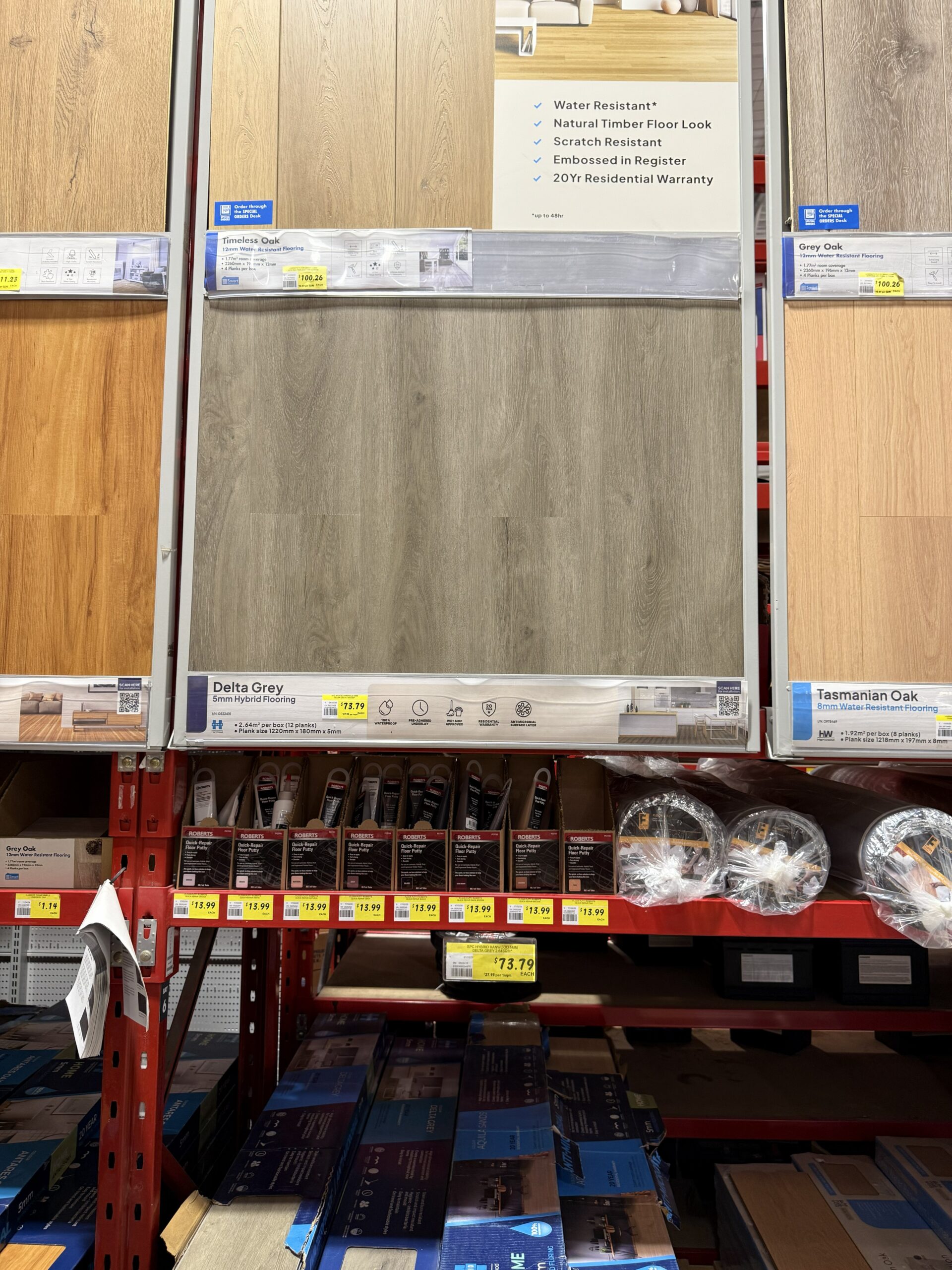
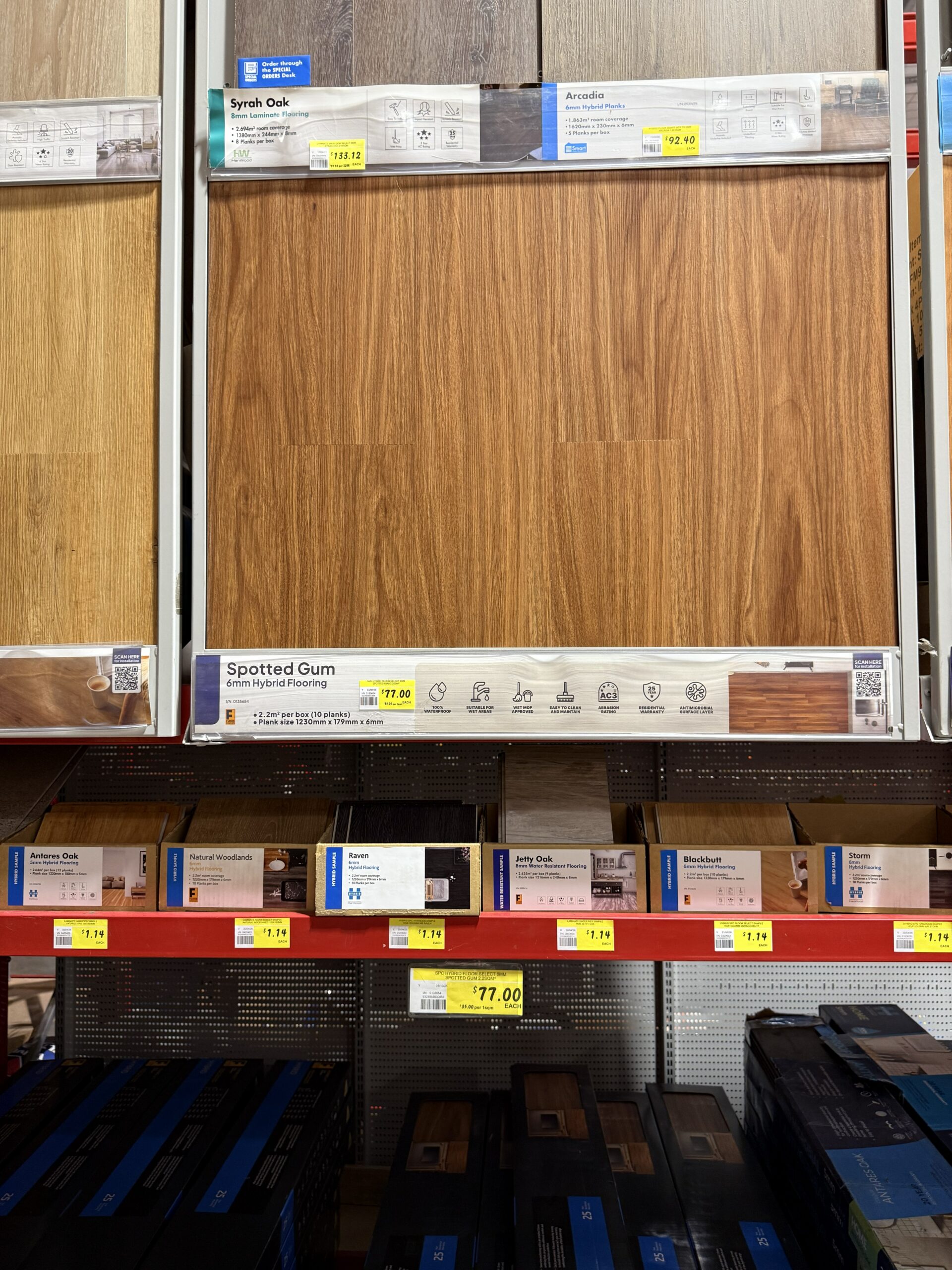
A practical note if you’re shopping at Bunnings: the in-store tags show the AC abrasion rating and the residential star rating (3 stars on this range), but not the wear-layer thickness in mils — you’ll need to phone or check the product page if that specific number matters for your application. Sample boxes are $1.14 each for the major colourways (Antares Oak, Delta Grey, Spotted Gum, Blackbutt, Storm, Desert Sand, Honed Slate, Natural Concrete) — worth grabbing two or three before committing to a colour.
These shelf prices place Bunnings firmly at the budget end of the SPC market — for European brands like Quick-Step you are typically looking at $70–$120/m² supply only.
Installation options and process
One of the biggest advantages of spc hybrid flooring is its click-lock floating installation system, which makes it genuinely DIY-friendly. Most SPC products use either an Angle-Angle or Drop-Lock click mechanism that requires no glue, nails, or special tools beyond a tape measure, utility knife, spacers, and tapping block.
The basic hybrid flooring installation process involves:
- Subfloor preparation: Ensure the existing floor is level (within 3 mm over 3 metres), clean, and dry. SPC can go over tiles, concrete, existing vinyl, or timber provided the surface is sound.
- Acclimatisation: Leave planks in the room for 24–48 hours so they adjust to ambient temperature and humidity.
- Underlayment: Many SPC products have integrated padding, but for concrete subfloors you may want an additional moisture barrier. Check manufacturer specs.
- Layout planning: Measure the room and plan your starting point to avoid narrow cuts at doorways. Stagger end joints by at least 300 mm for structural integrity and visual appeal.
- Installation: Click planks together row by row, maintaining a 10 mm expansion gap around the perimeter. Use spacers to keep this gap consistent.
- Trim and finishing: Install skirting or scotia to cover the expansion gap. Fit transition strips at doorways and where SPC meets other flooring types.
Experienced DIYers can complete a 20 sqm room in a weekend. If you’d rather leave it to professionals, a qualified hybrid flooring installer will typically finish the same space in 4–6 hours, including prep and trim.
Durability and performance in Australian homes
SPC hybrid flooring thrives in Australia’s diverse climate zones, from the humidity of Darwin to Melbourne’s temperature swings. The stone composite core doesn’t expand or contract like timber, which is why it’s approved for use over hydronic heating and in full-sun conservatories where other products would warp.
Key performance metrics:
- Wear layer thickness: This determines scratch resistance. A 0.5 mm wear layer handles normal family traffic; 0.7 mm+ suits commercial or heavy residential use.
- Indentation resistance: SPC cores typically withstand 1,000+ PSI, far exceeding WPC or laminate. You can roll a fridge across it without leaving marks.
- Water resistance: 100% waterproof core means spills, pet accidents, and even minor flooding won’t damage the floor. The seams are the vulnerable point—use quality planks with tight locking systems.
- UV stability: Quality SPC products include UV inhibitors in the wear layer to prevent fading in sun-drenched rooms, though prolonged direct sunlight can still cause some colour shift over years.
- Acoustic performance: SPC is denser than WPC, which can make it noisier underfoot in upstairs rooms. An acoustic underlayment (2 mm cork or foam) adds $8–$15 per sqm but significantly reduces sound transmission.
The Australian Building Codes Board doesn’t mandate specific flooring standards for residential applications beyond slip resistance in bathrooms, but SPC products generally meet or exceed AS 4586 P4/P5 ratings for wet areas when textured finishes are chosen.
Real-world longevity in Australian homes is impressive. Homeowners report 10–15 years of flawless performance in high-traffic zones, with premium products showing minimal wear even after a decade. The limiting factor is usually aesthetic preference—people want a style refresh—not structural failure.
Common mistakes to avoid
Even with its DIY-friendly design, spc hybrid flooring installation can go wrong if you skip critical steps. Here are the pitfalls to sidestep:
Ignoring subfloor preparation: SPC is rigid, but it’s not magic. High spots, debris, or a sloping subfloor will cause planks to rock, gap, or crack at the locking mechanism over time. Invest the effort to level and clean properly.
Skipping expansion gaps: Even though SPC has minimal thermal expansion compared to timber, it still needs 10 mm clearance around the perimeter and at fixed objects like kitchen islands. Butting planks hard against walls will cause buckling when the floor does expand.
Choosing the wrong wear layer for your use case: A 0.3 mm wear layer is fine for a guest bedroom, but it’ll show scratches within two years in a family living room. Match the spec to the traffic level.
Mixing leftover planks from different batches: Dye lots vary. If you’re topping up material from a previous purchase, colour and grain may not match perfectly. Order 10% extra on your initial buy to cover cuts and future repairs.
Installing over an uneven moisture barrier: Wrinkles or folds in plastic sheeting under SPC can create lumps that show through. Tape the barrier flat and smooth before laying planks.
Using SPC outdoors without checking suitability: Most SPC is for indoor use only. A handful of products are rated for covered outdoor areas, but direct weather exposure will degrade the wear layer and printed film. Always confirm the manufacturer’s guidelines.
FAQ
Is SPC hybrid flooring better than laminate?
Yes, for most Australian applications. SPC is 100% waterproof, more scratch-resistant, and dimensionally stable in humidity and temperature extremes. Laminate is cheaper but will swell and delaminate if exposed to moisture, making SPC the smarter long-term investment for kitchens, bathrooms, and laundries.
Can I install spc hybrid flooring over tiles?
Absolutely, provided the tiles are level, firmly adhered, and clean. Fill any grout lines that are deeper than 3 mm, and ensure there are no loose or cracked tiles. An underlayment can help smooth minor irregularities.
How do I clean and maintain SPC floors?
Sweep or vacuum regularly to remove grit, then damp-mop with a pH-neutral floor cleaner. Avoid steam mops (high heat can soften adhesive layers) and abrasive scrubbers. For scuffs, a magic eraser or a drop of methylated spirits on a cloth works wonders. SPC requires no waxing, polishing, or sealing.
Does spc hybrid flooring scratch easily?
SPC is highly scratch-resistant compared to laminate or engineered timber, but it’s not invincible. Dragging furniture without felt pads, dropping sharp objects, or tracking in coarse sand can still mar the surface. A 0.5 mm+ wear layer will handle typical family life, including pets, without visible damage for many years.
What’s the lifespan of SPC flooring in Australian conditions?
Quality spc hybrid flooring typically lasts 15–25 years in residential settings, with warranties reflecting that range. In high-traffic commercial environments, expect 10–15 years. The rigid core doesn’t degrade like wood composite, so the wear layer thickness and UV exposure are the main factors affecting longevity.
SPC hybrid flooring has earned its reputation as a practical, durable, and beautiful choice for Australian homes. Whether you’re renovating a coastal apartment in Sydney, a Queenslander in Brisbane, or a modern townhouse in Perth, the combination of waterproof performance, realistic aesthetics, and straightforward installation makes it a flooring solution that genuinely delivers on its promises. Take the time to choose the right wear layer thickness for your household, prepare your subfloor properly, and you’ll enjoy years of low-maintenance floors that look as good on day 3,000 as they did on day one.
Comparing quotes? Once you have 2-3 in hand, drop them into our free Renovation Quote Comparator to see totals side-by-side and catch the common red flags automatically.
Related guides
For more on Australian renovation costs, see:
- Ultimate Hybrid Flooring Guide Australia 2026
- Hybrid Flooring Brisbane: Ultimate 2026 Price Guide
- Best Hybrid Flooring Install Guide Australia 2026
- Best Hybrid Flooring Prices Guide Australia 2026
- Best Hybrid Flooring Bunnings Guide Australia 2026
- Best Hybrid Flooring Perth Guide 2026
Stay in the loop
One short email per month with what’s changed in Australian renovation pricing. No spam.