A flat-pack kitchen typically costs $3,000–$10,000 for cabinetry and installation in a standard three- to four-metre galley or L-shaped layout, while a custom-built equivalent runs $12,000–$35,000 or more. The difference comes down to materials, joinery methods, hardware quality and the way cabinets are measured and fitted, all of which affect both upfront price and how long the kitchen lasts. This comparison covers the real end-to-end costs of flat-pack and custom cabinetry in Australia, the durability trade-offs, and when each choice is sound.
What flat-pack and custom mean
Flat-pack kitchens are mass-produced cabinet boxes made from melamine-coated particleboard or MDF, cut to standard widths and heights, then packed flat for transport. You buy them off the shelf or online, assemble them yourself or pay a carpenter to do it, and install them against your walls. Brands such as IKEA, Kaboodle (Bunnings) and online retailers like The Blue Space and Kinsman offer modular ranges that you configure to fit your floor plan.
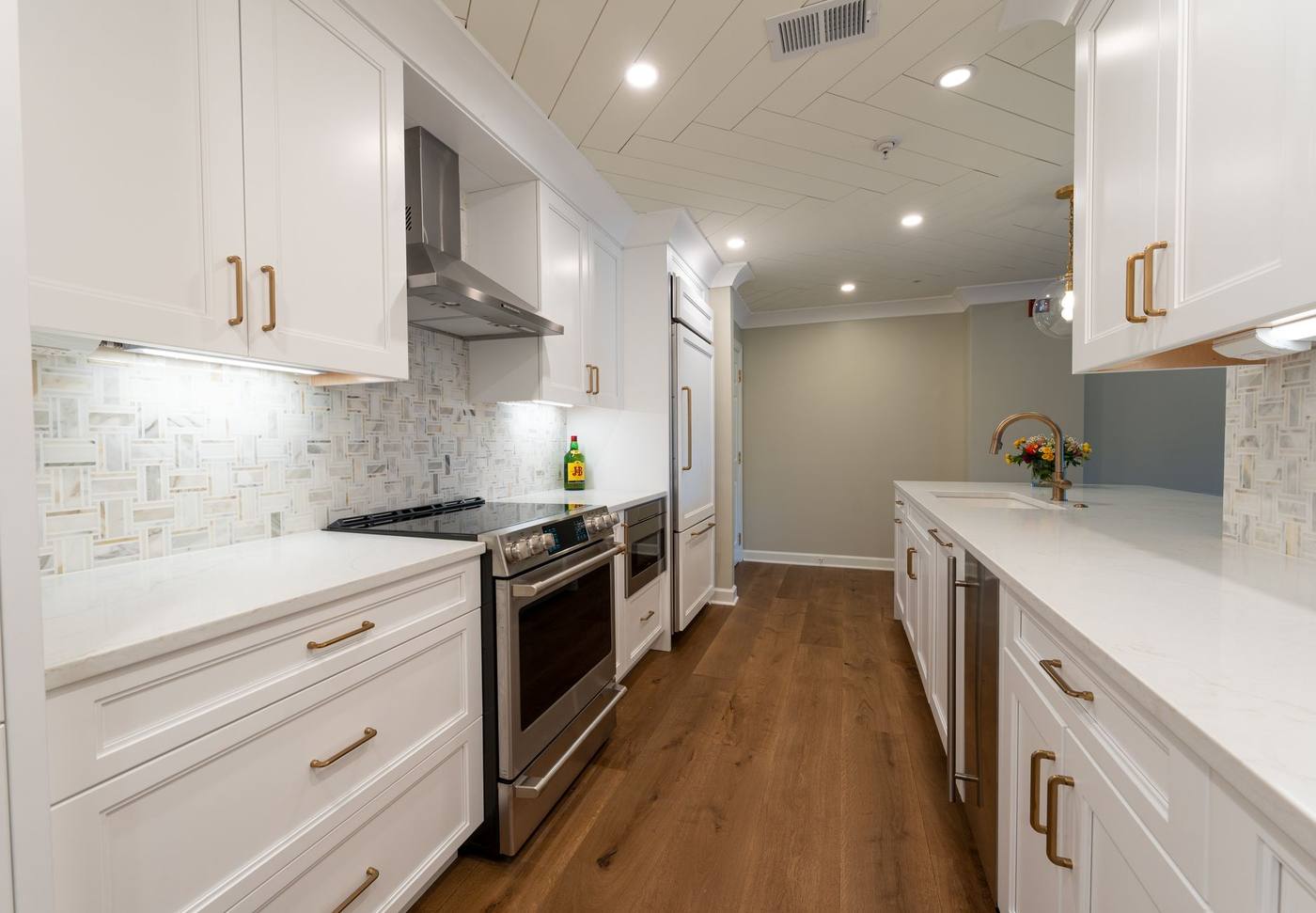
Custom kitchens are built to your exact measurements by a cabinetmaker or joiner, typically in their workshop. They use materials you choose—plywood carcasses, solid timber or high-grade board—joined by screws, dowels or cam locks, then finished with two-pack paint, timber veneer or laminate. Every dimension, shelf height, drawer depth and door style is tailored to your room and the way you cook.
Flat-pack vs custom kitchen cost breakdown
For a modest three-metre galley or L-shaped kitchen with base and wall cabinets, pantry and overhead cupboards, expect these indicative ranges in 2026:
- Flat-pack cabinetry: $2,000–$6,000 for cabinet boxes, doors, drawers and basic soft-close hinges.
- Flat-pack assembly and installation: $800–$3,000 if you hire a carpenter or handyman; $0 if you do it yourself.
- Total flat-pack: $3,000–$10,000 installed, excluding benchtop, sink, appliances and splashback.
- Custom cabinetry: $10,000–$30,000 for the same number of cabinets, built from plywood or quality board with concealed hinges, soft-close drawers on full-extension runners, and a two-pack or timber-veneer finish.
- Custom installation: usually included in the cabinetmaker's quote, or $1,000–$2,500 if billed separately.
- Total custom: $12,000–$35,000 installed, again excluding benchtop, appliances and tiling.
These figures assume a straightforward rectangular room with standard ceiling height and no structural changes. Add 20–40 per cent if you want floor-to-ceiling pantries, integrated appliance panels, pull-out spice racks, or intricate joinery details. A complete kitchen renovation will also include the benchtop (which can range from $1,500 for laminate to $8,000 or more for natural stone), plumbing, electrical rough-in, tiling and painting.
Materials and construction quality
Most flat-pack cabinets use 16 mm or 18 mm melamine-faced particleboard for carcasses, joined by cam locks and dowels. Doors are melamine, laminate or painted MDF. Shelves sit on plastic or metal pins, and drawer boxes are often thin melamine or polymer. Hardware—hinges, drawer runners, handles—is serviceable but rarely premium; soft-close mechanisms may wear out after five to eight years of daily use.
Custom cabinetmakers typically build carcasses from 18 mm plywood—birch-faced or structural hardwood ply—which resists moisture and screw pull-out better than particleboard. Joints are screwed and glued or use confirmat screws, and backs are recessed rather than stapled flush. Drawer boxes can be solid timber dovetailed or 12 mm ply with Blum Tandembox or similar metal systems. Hinges are concealed European-style from Blum, Hettich or Hafele, rated for tens of thousands of cycles. Doors might be two-pack polyurethane (smooth, durable, repairable), timber veneer or high-pressure laminate in any colour.
The material difference shows up in three ways: how square and rigid the cabinets stay over time, how they handle moisture around sinks and dishwashers, and whether you can tighten, adjust or replace hardware without stripping the substrate.
Installation, fit and finish
Flat-pack cabinets come in fixed widths—300 mm, 450 mm, 600 mm, 900 mm—so you fill your wall by combining modules and covering gaps with filler panels or scribing to uneven walls. If your room is 3,240 mm wide, you might end up with a 40 mm gap or a slightly proud benchtop overhang. Floors and walls are rarely plumb, so installers scribe and shim, but the modular increments limit how tight the fit can be.
Custom cabinets are made after a site measure, so each run is cut to fill the exact span. The cabinetmaker accounts for out-of-square corners, sloping floors and bulkheads, and trims carcasses or scribe strips on site. You get consistent reveals, aligned door lines and benchtops that sit flush against splashbacks. The labour cost is higher because the joiner spends more time measuring, building jigs and fine-tuning, but the result looks continuous rather than assembled from boxes.
Longevity and repair
A well-assembled flat-pack kitchen in a low-moisture environment can last ten to fifteen years before hinges sag, particleboard edges swell near the sink, or cam-lock joints loosen. Budget another $500–$1,500 midway through that span to replace drawer runners or hinges if they fail. Particleboard does not hold screws well after the first fix, so rehinging a door or reattaching a loose shelf bracket often means drilling a new pilot hole or using a larger fastener.
Custom plywood kitchens routinely last twenty to thirty years. Plywood carcasses tolerate minor leaks without delaminating, and quality European hinges can be adjusted or replaced without new drill holes. If a door is damaged, a cabinetmaker can make a new one to match the grain or paint. Drawer systems such as Blum Tandem or Grass allow you to swap the front without disturbing the box. Two-pack finishes can be spot-repaired and resprayed.
Depreciation matters if you plan to sell within five years: a tired flat-pack kitchen with chipped edges and wobbly doors signals deferred maintenance; a custom kitchen that still closes smoothly adds perceived value, even if the style is dated.
When flat-pack makes sense
Flat-pack is a sound choice if you are renovating an investment property for lease, updating a kitchen in a home you will sell soon, or working within a strict budget that leaves no room for custom joinery. It is also practical if you enjoy DIY: many flat-pack ranges ship with clear instructions, pre-drilled holes and all fixings, so a confident home renovator can assemble and install a small kitchen over a long weekend.
Flat-pack works well in simple rectangular layouts without tricky ceiling bulkheads, angled walls or non-standard appliance gaps. If your room measures close to modular increments and you are comfortable with filler strips, you will not sacrifice much in appearance. Pair flat-pack cabinets with a quality benchtop—porcelain, laminate or natural stone—and decent handles, and the overall result can look tidy and functional.
Some homeowners replace only the doors and drawer fronts on old flat-pack carcasses, a strategy that costs $1,200–$3,000 and buys another five years if the boxes are still square. Just check that hinge holes have not stripped and that the carcass edges are intact.
When custom is worth the premium
Custom cabinetry makes sense if you plan to stay in the home for ten years or more, if the kitchen is the hub of daily life, or if the room has awkward dimensions—narrow galley, cathedral ceiling, heritage cottage with uneven floors. It is also the better choice where moisture is a concern: near coastal salt air, in tropical climates, or around undermount sinks and integrated dishwashers where particleboard edges will eventually swell.
If you cook seriously and need deep drawers for pots, adjustable spice pull-outs, or bin systems that do not wobble, custom joinery delivers hardware and tolerances that flat-pack ranges cannot match. Custom also lets you specify timber species, paint colour and internal fittings—plate racks, knife slots, appliance garages—that suit the way you work.
When resale value matters, particularly in suburbs where kitchens are a decision point for buyers, a well-executed custom kitchen justifies its cost by lifting the home's overall presentation. The joinery does not have to be exotic; plywood carcasses with two-pack doors in a neutral colour and quality hardware will outlast and out-perform most flat-pack equivalents.
Overlaps and hybrids
Some cabinetmakers offer semi-custom ranges: modular carcasses in standard widths but built from plywood with quality hinges and drawers, then finished to order. These sit between flat-pack and full custom in both price and flexibility, typically $8,000–$18,000 for a small to medium kitchen. You lose some tailoring but gain material quality and better hardware at a mid-range cost.
Another hybrid is to use flat-pack base cabinets where loads are light and moisture low—pantry, broom cupboard—and invest in custom cabinetry around the sink, dishwasher and cooktop where durability matters most. This approach can trim $3,000–$5,000 from a custom quote while protecting the highest-risk zones.
Other costs to budget
Both flat-pack and custom quotes exclude the benchtop, which is usually templated and installed separately. Laminate benchtops start around $150–$250 per linear metre installed; porcelain or sintered stone runs $600–$1,200 per metre; natural stone (granite, marble) sits between $500 and $1,000 per metre. You can compare materials and indicative prices in detail on the benchtop cost guide.
Allow $800–$2,000 for a plumber to relocate taps, fit a new sink and reconnect the dishwasher; $600–$1,500 for an electrician to move power points, install under-cabinet lighting and certify the work; and $1,000–$3,000 for splashback tiling (or $400–$800 for an acrylic or glass sheet). Painting walls and ceilings after cabinetry is in adds another $600–$1,200 for a typical kitchen. Together these ancillary trades can add $3,000–$8,000 to the project, regardless of whether you chose flat-pack or custom cabinets.
Common mistakes to avoid
Choosing flat-pack for a coastal or humid environment without sealing cut edges is a common cause of early cabinet failure. Particleboard swells quickly once water reaches the core; seal all cut edges with silicone or edge tape during assembly.
Underestimating assembly time leads to frustration and hire-tool costs. A ten-cabinet flat-pack kitchen takes an experienced DIYer twelve to twenty hours; first-timers often need a full weekend plus evenings. If you are paying a carpenter by the hour, get a fixed-price quote for assembly and install rather than an open-ended day rate.
Skipping a site measure before ordering flat-pack is risky. Measure twice, account for skirting boards, cornices and window sills, and draw a scale plan. Most flat-pack retailers offer free design software, but the software assumes square rooms; verify that walls are plumb and corners are ninety degrees.
Combining cheap cabinets with an expensive stone benchtop creates an imbalance: the benchtop may outlast the carcasses by a decade, and you will struggle to justify replacing sound stone when the cabinets fail. Match cabinetry quality to benchtop longevity, or plan for a staged upgrade.
Forgetting to budget for handles, plinths and scribe strips is another trap. Many flat-pack quotes exclude handles (add $10–$40 per cabinet) and plinths (around $15–$25 per linear metre), so the advertised price climbs by $300–$800 at checkout.
FAQ
Can you install a stone benchtop on flat-pack cabinets?
Yes, provided the carcasses are level, properly secured to the wall, and have adequate bracing. Stone fabricators will add support rails or plywood strips across the top of base cabinets if needed. Let the fabricator know you are using flat-pack so they can assess the structure during templating.
How long does a flat-pack kitchen take to install?
Assembly and installation by a professional carpenter typically takes two to four days for a standard kitchen, depending on complexity and the number of cabinets. DIY assembly adds time; expect a weekend or longer for your first flat-pack project. The overall renovation timeline will also include plumbing, electrical, benchtop templating and splashback tiling.
Do custom kitchens always use solid timber?
No. Most custom cabinets use plywood carcasses for strength and stability, with doors and drawer fronts in timber veneer, two-pack polyurethane or laminate. Solid timber is reserved for face frames, doors or feature panels where its grain and thickness add visual weight. Plywood is more dimensionally stable than solid timber and less prone to warping in Australian climates.
Is it worth upgrading hinges and drawer runners on flat-pack cabinets?
Upgrading to Blum Blumotion hinges and Tandem drawer runners can add $400–$800 to a flat-pack kitchen, but it improves longevity and daily feel. The particleboard carcass remains the weak point, so the upgrade makes most sense if you plan to keep the kitchen for at least eight to ten years and the carcasses are well assembled and sealed.
Can a cabinetmaker repair a flat-pack kitchen?
Minor repairs—replacing a hinge, realigning a door, adding a missing shelf pin—are straightforward. Structural repairs to stripped cam-lock holes or swollen particleboard edges are harder and often not cost-effective; by the time multiple cabinets need work, replacement is usually cheaper than repair.
Choosing between flat-pack and custom comes down to how long you need the kitchen to last, how much the room challenges standard dimensions, and whether the budget allows for materials and joinery that tolerate daily wear and moisture. Both paths deliver a working kitchen; the difference lies in how well it ages and how much remedial work you will fund in year seven or twelve.
Comparing quotes? Once you have 2-3 in hand, drop them into our free Renovation Quote Comparator to see totals side-by-side and catch the common red flags automatically.