You’re weighing up whether to renovate your tired bathroom before selling, or pocket the renovation budget and list as-is. Understanding how much bathroom renovation cost add to home value is crucial for making the right financial decision. Australian property data consistently shows that bathroom upgrades deliver strong returns, but not all renovations are created equal—and timing matters.
What’s in this guide
- Typical ROI from bathroom renovations
- Best bathroom upgrades for maximum return
- Which bathroom upgrades waste money
- Factors that affect your bathroom renovation ROI
- Common mistakes to avoid
- Break-even analysis and resale timing
- FAQ
Typical ROI from bathroom renovations
Australian bathroom renovations typically return between 60% and 80% of the investment cost when you sell, according to property market analysis from Domain and industry research. This means if you spend $25,000 on a bathroom renovation, you can expect to add approximately $15,000 to $20,000 to your home’s sale price.
The exact return on how much bathroom renovation cost add to home value depends heavily on your property’s location, condition, and market segment. In high-demand metro areas like Sydney’s inner suburbs or Melbourne’s east, bathroom renovations can return up to 85% of costs. Properties in Brisbane’s growth corridors and Perth’s established suburbs typically see returns in the 65–75% range.
Here’s what the numbers look like across different renovation scales:
- Budget refresh ($8,000–$12,000): Adds $5,000–$9,000 to sale price (60–75% return)
- Mid-range renovation ($18,000–$28,000): Adds $13,000–$21,000 to sale price (70–80% return)
- High-end renovation ($35,000–$50,000+): Adds $21,000–$37,500 to sale price (60–75% return)
While you rarely recoup 100% of your investment immediately, a renovated bathroom significantly reduces time on market. CoreLogic research indicates homes with updated bathrooms sell 12–18 days faster than comparable properties with dated facilities—and in a competitive market, that speed advantage often translates to stronger negotiating power.
Best bathroom upgrades for maximum return
Not all bathroom improvements deliver equal value. When considering how much bathroom renovation cost add to home value, these upgrades consistently provide the strongest returns:
High-return bathroom upgrades
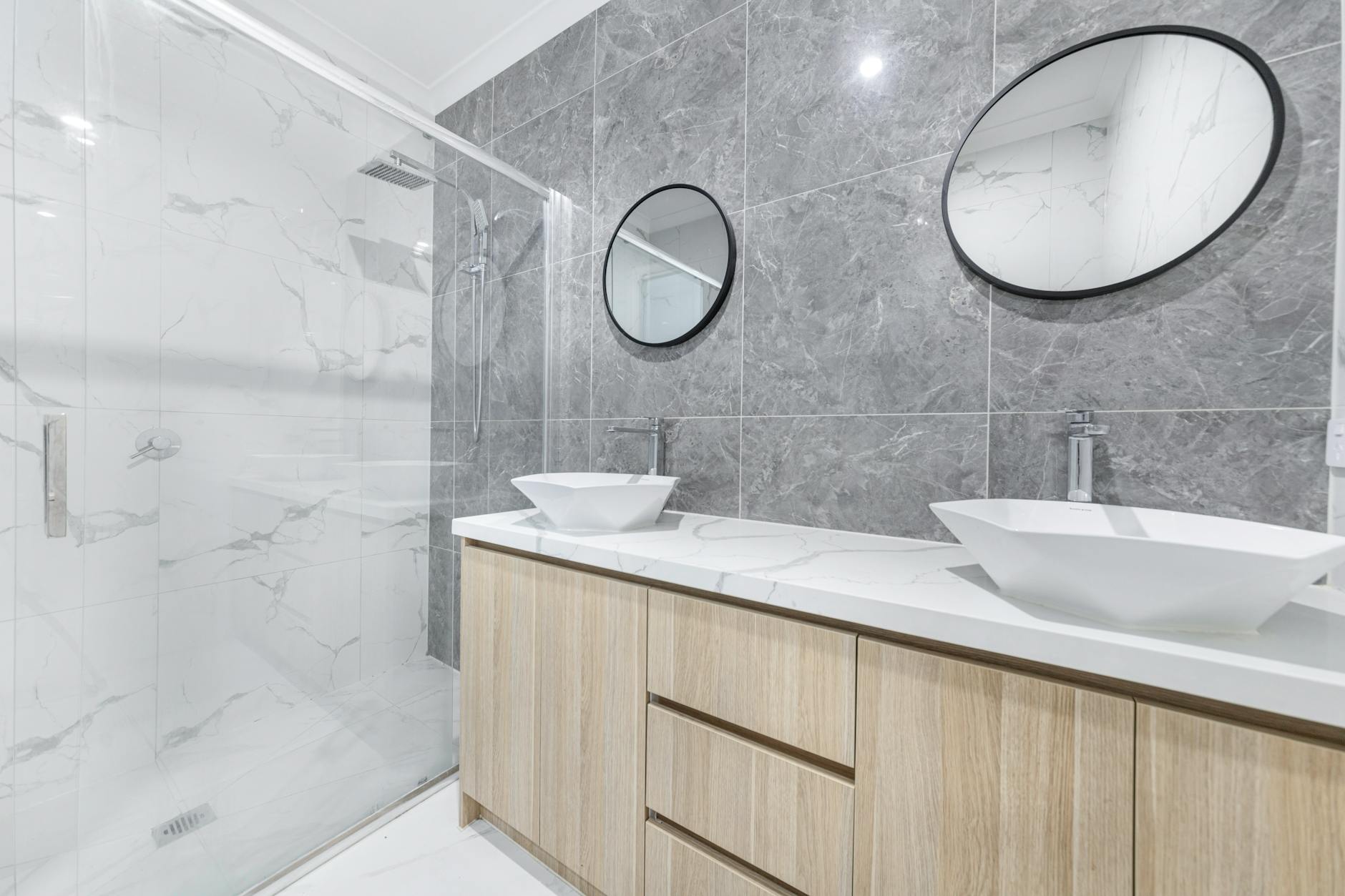
Modern vanity and storage: A quality vanity with soft-close drawers and stone or engineered stone benchtop returns approximately 85–90% of its cost. Buyers highly value functional storage, and a well-chosen vanity instantly modernises the space. Budget $1,200–$3,500 depending on size and finish.
Shower upgrade: Replacing an old bath-shower combo with a walk-in frameless shower adds considerable appeal, particularly to downsizers and young professionals. This upgrade returns 75–85% and typically costs $3,500–$7,000 installed. Quality tiling work in the shower zone is essential—don’t cut corners on waterproofing.
Fresh tiling and grout: Clean, contemporary floor and wall tiles transform a bathroom’s appearance. Neutral, large-format tiles (600×600mm or larger) appeal to the broadest buyer pool. Expect to invest $80–$140 per square metre installed and recover 70–80% at sale.
Updated fixtures and fittings: Replacing dated tapware, showerheads, towel rails, and toilet with modern chrome or matte black equivalents costs $800–$2,000 but returns 80–90%. This relatively small investment makes a disproportionate visual impact.
Improved lighting: Swapping a single ceiling light for LED downlights plus a backlit mirror adds ambience and functionality. At $600–$1,200, this upgrade returns around 75% and photographs exceptionally well in listings.
Proper ventilation: Installing or upgrading an exhaust fan (particularly a quiet model with humidity sensor) costs $300–$800 but addresses a major buyer concern about mould and moisture. Returns are hard to quantify directly but contribute to overall bathroom quality perception.
Which bathroom upgrades waste money
Understanding bathroom renovation cost add home value means knowing what not to spend on. These upgrades rarely deliver worthwhile returns:
Luxury spa features: Heated floors, chromotherapy lighting, steam showers, and high-end spa baths appeal to a narrow buyer segment. You’ll typically recover only 30–50% of these costs. Unless your property is in the luxury market (over $2 million), avoid them pre-sale.
Over-specification for the neighbourhood: Installing $15,000 worth of Italian marble in a $600,000 suburban home won’t yield returns. Buyers expect finishes appropriate to the price point. Match or slightly exceed neighbourhood standards—don’t dramatically overshoot.
Boutique or trendy finishes: Patterned encaustic tiles, coloured tapware, or statement wallpaper might suit your taste, but they polarise buyers. Stick with timeless, neutral palettes for maximum appeal and return.
Expanding bathroom footprint: Stealing space from an adjacent bedroom to enlarge a bathroom rarely makes financial sense unless you’re correcting a severe size deficiency. The cost-per-square-metre of structural work ($4,000–$8,000+ per wall moved) rarely returns more than 40–50%.
Double vanities in small spaces: Cramming a double vanity into a compact bathroom makes it feel claustrophobic. If the bathroom is under 4 square metres, a well-proportioned single vanity with ample storage delivers better value.
Factors that affect your bathroom renovation ROI
Several variables influence how much bathroom renovation cost add to home value in your specific situation:
Current condition: If your existing bathroom is severely dated (think 1980s pink tiles and avocado suite), renovation returns will be higher—potentially 75–85%—because you’re solving a major buyer objection. If your bathroom is merely tired but functional, returns drop to 60–70%.
Property price bracket: Mid-market homes ($600,000–$1.2 million in most capitals) see the strongest bathroom renovation returns because buyers in this segment expect modern amenities. In the entry-level market, buyers may prefer to DIY; in the luxury segment, expectations are so high that standard renovations won’t impress.
Local market conditions: In a hot seller’s market, bathroom renovations can push returns toward the upper end of the range (75–85%) because competition among buyers intensifies. In a soft market, returns may settle at 55–65% as price becomes the dominant factor.
Number of bathrooms: Renovating your only bathroom or the main family bathroom delivers better returns than updating an ensuite or third bathroom. Focus renovation dollars where they’ll have the most impact on daily liveability.
Quality of workmanship: Shoddy tiling, poorly finished silicone, or misaligned fixtures actively harm value. Buyers—and their building inspectors—notice poor work. Always use licensed tradespeople and get appropriate permits for plumbing and electrical changes as required under the Building Code of Australia.
Common mistakes to avoid
Many homeowners undermine their bathroom renovation ROI through avoidable errors:
Renovating for personal taste rather than resale: Your love of Moroccan zellige tiles or bold black grout won’t necessarily translate to buyer appeal. When renovating pre-sale, choose safe, contemporary finishes in neutral tones. Save the statement pieces for your next home.
Ignoring the rest of the property: A $30,000 bathroom renovation can’t compensate for peeling exterior paint, worn carpet, or an outdated kitchen. Buyers assess overall property condition. If your bathroom renovation budget means neglecting other obvious issues, reconsider the scope or pricing strategy.
DIY plumbing or waterproofing: Bathroom waterproofing must comply with AS 3740, and plumbing work requires a licensed plumber in all Australian states. Cutting corners here risks leaks, mould, and failed building inspections—any of which will crater your sale price and potentially torpedo a contract.
Renovating too close to settlement: Plan bathroom renovations at least 8–12 weeks before listing. Rushed work invites mistakes, and buyers distrust fresh renovations that haven’t been “tested” through a few months of use. The smell of fresh paint and silicone can paradoxically raise red flags.
Forgetting ventilation and lighting: Dark, poorly ventilated bathrooms feel oppressive. Even a budget renovation should include adequate extraction (minimum 25 litres per second for bathrooms under 8m²) and multiple light sources. Natural light via a window or skylight dramatically boosts appeal if feasible.
Inconsistent style: Mixing modern tapware with traditional tiles, or pairing a sleek floating vanity with ornate lighting, creates visual confusion. Commit to a cohesive style—contemporary, Hamptons, or industrial—and carry it through all elements.
Break-even analysis and resale timing
Determining whether bathroom renovation cost add home value in your situation requires honest break-even analysis. Calculate your total renovation spend (including project management, permits, and contingency), then multiply by your expected return rate (use 70% as a conservative estimate).
For example, if you’re considering a $22,000 bathroom renovation, you’d expect to add approximately $15,400 to your sale price (70% return). Factor in selling costs—agent commission (typically 1.8–2.5%), marketing ($3,000–$8,000), and conveyancing ($1,200–$2,500)—and the net benefit might be closer to $12,000–$13,000.
Now consider your timeline. If you plan to sell within 3–6 months, that $22,000 renovation yielding $13,000 net represents a $9,000 loss—but you may sell faster and achieve a cleaner sale without price negotiation over bathroom condition. If you’ll live in the renovated bathroom for 1–2 years before selling, you’re also buying improved daily amenity, which has intangible value.
When bathroom renovation makes financial sense
- Your existing bathroom is in poor condition and will be flagged in buyer inspections
- Comparable properties in your area have updated bathrooms (you’re falling behind market expectations)
- You’re selling in a competitive market where presentation is crucial
- You’ll enjoy the renovation for 12+ months before selling
- Your property is otherwise in good condition and the bathroom is the obvious weak point
When to skip the renovation
- You’re in a slow market where price trumps presentation
- Your bathroom is functional and clean, just dated in style
- You need to sell within 4–8 weeks (insufficient time for quality work)
- Your renovation budget would exceed 8–10% of the property’s value
- Multiple other issues (roof, electrical, structural) need addressing first
If you’re comparing bathroom renovation costs across Australia, regional variations can significantly affect both outlay and return. Metro markets generally offer better returns but higher renovation costs, while regional areas may see lower costs but also more conservative buyer expectations.
Resale timing strategy
For optimal return, list your property 2–6 months after completing the bathroom renovation. This window allows:
- Any minor defects or issues to surface and be rectified
- Finishes to settle and cure properly
- The “new renovation smell” to dissipate (which some buyers find suspicious)
- You to accumulate utility bills and council rates notices showing normal occupancy
Listing immediately after renovation can trigger buyer scepticism (“why are they selling so soon after renovating?”), while waiting more than 12 months means the renovation no longer feels “new” to buyers, reducing its psychological impact.
FAQ
Does a bathroom renovation always add value to your home?
Yes, a well-executed bathroom renovation almost always adds measurable value, but rarely at a 1:1 ratio. Expect to recoup 60–80% of costs at immediate resale. The value proposition improves if you enjoy the renovation for a period before selling, or if the existing bathroom is in genuinely poor condition.
Which bathroom renovation gives the best ROI?
A mid-range renovation focusing on vanity replacement, fresh tiling, updated fixtures, and improved lighting typically delivers the best balance of cost versus return (70–80% ROI). Avoid budget shortcuts that look cheap and luxury features that appeal to limited buyers.
Should I renovate the bathroom before selling?
Renovate if your bathroom is visibly dated or dysfunctional and comparable properties in your area have modern bathrooms. Skip the renovation if your bathroom is clean and serviceable, or if other major property issues need addressing first. Consider your local market’s competitiveness and your timeline.
How much value does a new bathroom add in Australia?
A new bathroom typically adds $15,000–$25,000 to property value in metro markets, depending on renovation scope and property price point. Regional areas may see $10,000–$18,000 value uplift. These figures represent 65–75% return on a $20,000–$30,000 renovation spend.
Is it better to renovate or discount the price?
If your bathroom needs work, discounting often costs you more than renovating. Buyers tend to overestimate renovation costs and may demand a $25,000 discount for a bathroom that would cost $18,000 to update. Renovating also reduces negotiation friction and appeals to buyers who can’t or won’t tackle renovations themselves—a significant portion of the market.
Understanding how much bathroom renovation cost add to home value gives you the data to make a strategic decision. Focus on mid-range upgrades using quality materials and licensed tradespeople, match your finishes to neighbourhood expectations, and time your sale to maximise both financial return and market appeal. Whether you’re preparing to list or planning ahead, a thoughtfully executed bathroom renovation remains one of the most reliable ways to enhance your property’s marketability and final sale price.
Related guides
For more on Australian renovation costs, see: